Anniversary in Washington DC - October, 1999 -- U. S. S. Maine Memorial in Arlington National Cemetery
First |
Previous Picture |
Next Picture |
Last | Thumbnails
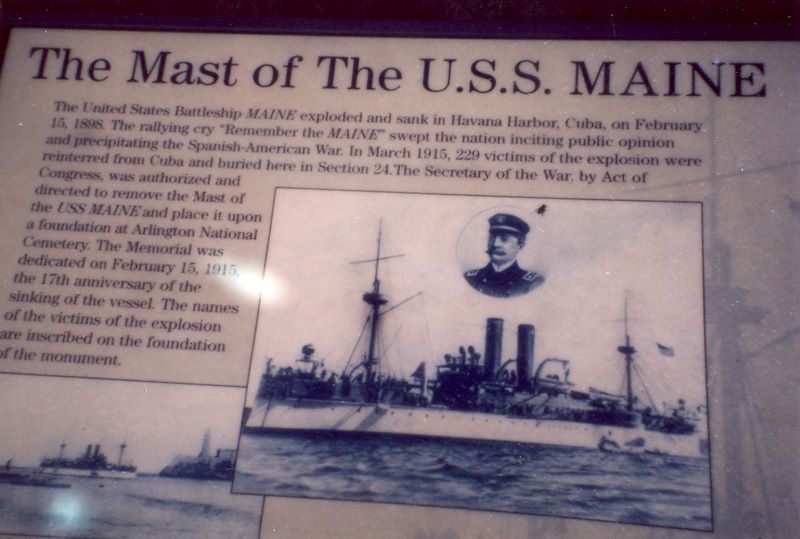 The mast of the U.S.S. Maine was removed from the ship in 1905 shortly before the ship was taken out to sea and sunk with military honors. The mast was then installed above a memorial in Arlington National Cemetery in honor of those who lost their lives when the ship sank in Havana, Cuba, Harbor in 1898. This sinking was the event that started the Spanish-American War.
The sinking of the battleship USS Maine in Havana harbor on February 15, 1898 was the seminal event leading to the Spanish-American War. Although the cause of the explosion (whether a Spanish torpedo or an internal mechanical malfunction) has never been definitively determined, the event enraged American public opinion, and on 19 April Congress declared war on Spain. The Spanish forces were defeated with relative ease, and the United States eventually acquired Cuba, Puerto Rico, Guam, and the Philippines as colonies.
In late 1899 the remains of 163 of the sailors and marines who died in the explosion were removed from the semi-submerged ship. They were laid to rest with solemn ceremony in their own section of Arlington National Cemetery on 28 December of that year. An anchor from a similar battleship, and two flanking 18th century Spanish mortars brought back from Manila by Admiral Dewey, were installed as the first memorial to the victims of the USS Maine.
The ruins of the battleship remained in Havana harbor for another decade. Finally, bowing to both American and Cuban public pressure, the Navy built cofferdams around the ship to re-examine the ruins and to remove the remaining human remains, before towing the ship out to sea and scuttling it in 1912. During this time, the ship's main mast was removed and brought to Arlington to form part of a larger memorial, to be located adjacent to the interred sailors and marines. A design competition for the USS Maine Memorial was held in 1912. The results, however, were deemed unsatisfactory, and the Commission of Fine Arts subsequently commissioned prominent Washington architect Nathan C. Wyeth to design the memorial.
The memorial, as designed by Wyeth and dedicated in 1913, is in the form of a circular, stylized turret, serving as the base for the mast. Constructed of concrete, it is sheathed on the interior by marble, and on the exterior by granite. 23 panels on the exterior list the names and occupations of the 264 sailors and marines who perished when the ship sank. Stylized granite Roman tripods flank the entrance. A fragment of the ship's bell is attached to the massive bronze door. The nautical theme is reinforced by the use of metal rope and emblematic anchors on the bronze entrance gate. Bronze grills fill the 11 slit windows. The interior ceiling is in the form of a shallow saucer dome, and the floor is of mosaic tile. The entire memorial is flanked by two granite balustrades across the circumferential road surrounding the structure.
The USS Maine Memorial acquired additional historical significance by serving as the temporary resting place for the remains of Ignace Jan Paderewski, noted Polish patriot and internationally renowned concert pianist, from 1941-92. In 1962, a terrace paved with bluestone flagging was constructed for the anchor and mortars.